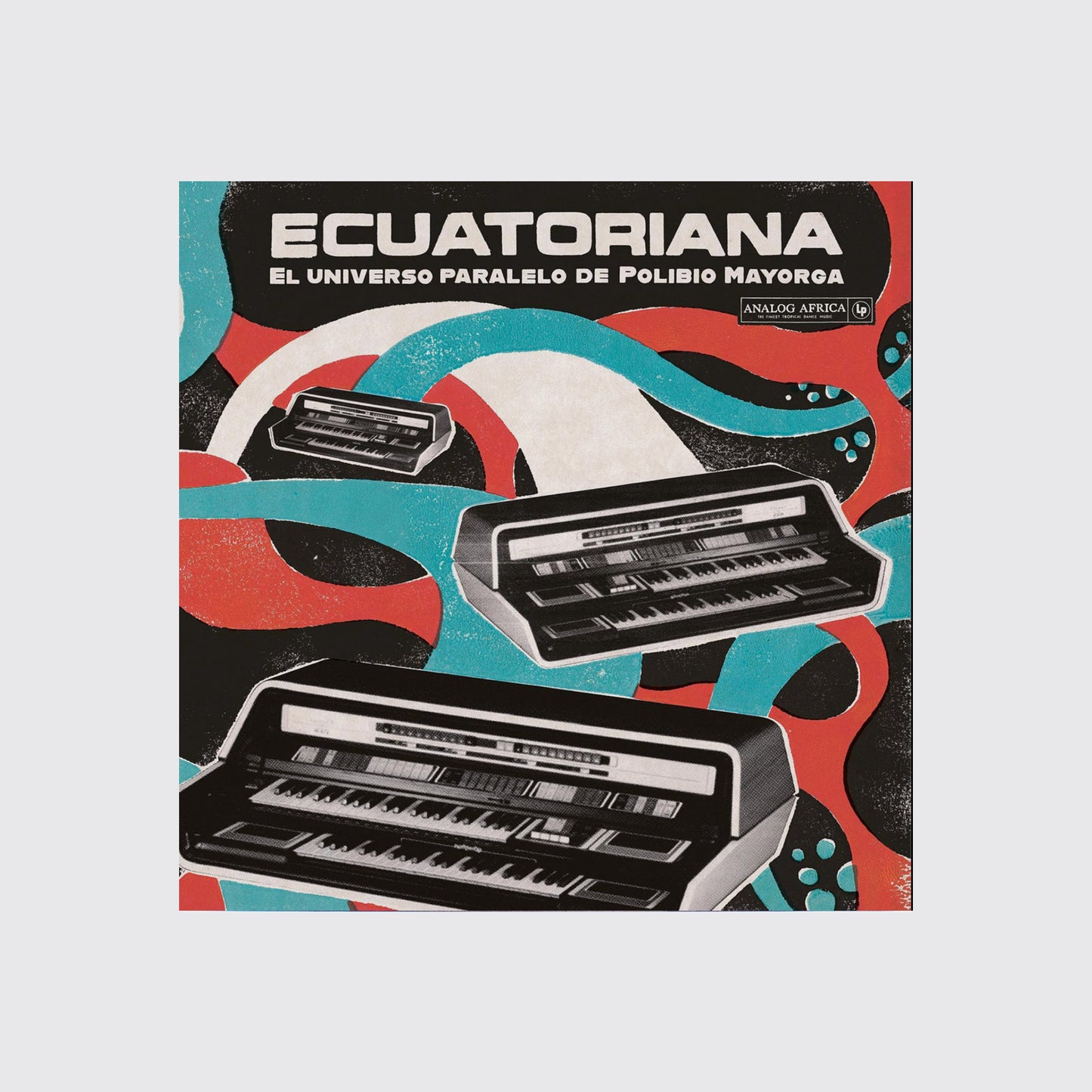
LP / ECUATORIANA. The Parallel Universe of Polibio Mayorga 1969-1981
LP / ECUATORIANA. The Parallel Universe of Polibio Mayorga 1969-1981
Couldn't load pickup availability
Ecuatoriana
The Parallel Universe of Polibio Mayorga 1969-1981
Analog Africa No. 37
180 gram disc
Released on April 7, 2023
Pressed in Germany
On February 12, 1949, an angry mob stormed into the center of Ecuador's capital, Quito, setting fire to the offices of the city's main newspaper and its oldest radio station.
On that tragic day, Radio Quito had just broadcast a local adaptation of H.G. Wells's The War of the Worlds. The novel—first published in 1898 and famous for its radio adaptation by Orson Welles—is one of the earliest stories to depict a conflict between humanity and a hostile race of extraterrestrials.
The vast audience, unaware that it was pure fiction, believed that an intergalactic intelligence had invaded the country, and chaos erupted. Thousands of people began running through the streets of Quito seeking refuge; the disorder triggered a deadly stampede. People blamed the radio station for the tragedy, formed a mob, and stormed Radio Quito, setting it ablaze. Several musicians who were performing there perished.
In the decades following World War II, outer space was on everyone's mind, and the space race of the 1950s and 1960s not only produced huge advances—such as the launching of artificial satellites, space probes to Mars, and the arrival of humans on the Moon—but also had a huge impact on the film and music industries.
Instrument makers capitalized on the global fascination with space travel to create devices capable of mimicking imagined interplanetary sounds. These synthesized space effects, which captivated the imagination of a whole generation of young Ecuadorians, coincided with a period when workers and musicians from the provinces began migrating to Quito and the commercial port of Guayaquil. Some sought stable employment; others hoped to break into the music world by being hired by one of the prestigious urban radio stations.
These artists brought with them a wealth of rhythms to the great Ecuadorian cities, which would soon witness the explosion of what would become known as "Andean cumbia".
That fusion of tropical electronica with Andean melodies and lyrics describing the harsh reality of migrant workers achieved enormous success. And so, while Ecuador's growing interest in UFOs generated numerous extraterrestrial sightings, the country's musicians began releasing albums that combined traditional music with synthesizers to take their sounds into the "space age."
One of these musicians was Polibio Mayorga, who had traveled 160 kilometers from his hometown of Chisalata to Quito, where he demonstrated his talent by modernizing ancestral rhythms of his region — such as the huaynito, the sanjuanito, the albazo and many others — using the latest electronic instruments.
After four years with Los Locos del Ritmo, one of Ecuador's most popular bands, Polibio joined Fadisa (Fábrica de Discos SA) in 1973 as a solo musician and composer, before becoming its musical director a year later.
During his time there he teamed up with the extraordinary saxophonist Olmedo Torres, and for ten years they composed and arranged hits not only for themselves, but also for other artists on the label.
Although Fadisa had many sub-labels in its catalog, the crown jewel was Rondador, and it was under this label that Polibio released “Ponchito de Colores” and his famous album “La Farra Está Aquí.” Thanks to his innovative use of the Moog synthesizer, both records became huge hits and were constantly played on Cosmopolita and Marañón de Quito, the two main radio stations in the capital.
This sparked a huge increase in interest in Andean cumbia, and subsequent record sales helped revitalize the Ecuadorian music industry, making Polibio the most influential musician in the country.
Polibio has never considered his music to be “tropical psychedelia”—though he thinks it would be a good name for a band. He has the sense of humor of a genius and the ability to make anyone laugh, yet he remains discreet, eloquent, and humble. However, as a musician, he is bold and visionary, with a fearless and vigorous style that is almost impossible to imitate.
More than perhaps any of his contemporaries, Polibio Mayorga managed to establish a unique place for himself at the forefront of tropical music.
-Analog Africa-
Tracklist. Duration: 41 minutes
1. Junior and His Team — America India — 2:54
2. Eduardo Morales y Su Requinto — Muévase Vecina — 2:13
3. Polibio Mayorga — Silk Handkerchief — 2:18
4. Polybius and His Vibraphone — Late Hours — 2:10
5. Los Locos del Ritmo — Llorona — 2:41
6. Alcibiades and His Band — Making a Bomb — 2:40
7. Olmedo Torres and Polibio Mayorga — My Paisa — 2:52
8. Polibio Mayorga y Su Conjunto — Culebrita Dormida — 2:58
9. Orti, Mayorga and Chiriboga — Little White Doll — 2:40
10. Olmedo Torres and Polibio Mayorga — Unita Más — 2:20
11. Alcibiades and His Band — Poor Man's Bomb — 2:30
12. Olmedo Torres and Los Gatos — Don Alfoncito — 2:13
13. Polibio Mayorga — Railroad — 2:45
14. Orti, Mayorga and Chiriboga — Say You Love Me — 2:43
15. Conjunto La Jorga — La Perra Vida — 2:23
16. Polibio Mayorga y Su Conjunto — Cumbia Totorana — 2:42
All songs, except Don Alfoncito, composed, arranged, produced or performed by Polibio Mayorga
Graphic design: Mauricio Zuffo Kuhlmann (MZK) and Yacine Blaiech (Mogli Studio)
Text: Juan Mullo Sandoval and Samy Ben Redjeb
Translation: Ricardo Luiggi (DJ Tres Dos)
Mastering: Michael Graves (Osiris Studio)
Text editing: Jesse Simon
Special thanks to: Esteban Mendieta Jara “El Surco”, Luis Alberto “EcuAntología Musical”, Darío Maldonado Cardeño “Ritmonzón”, Eamon Ore-Giron “DJ Lengua”, Ruffy “Discodelic”, Carmina Mayorga, Björn Larsson (Timetableimages), Diego Hernández (Eck Echo Berlin), Pablo E. Yglesias “DJ Bongohead” (Peace & Rhythm), Jhon Henry Eche (Musicoteca Ecuador), Carlos Javier Pérez Samudio (Candelazos Tropicales), Iván Medellín (Conjunto Media Luna) and Ilka Schlockermann.