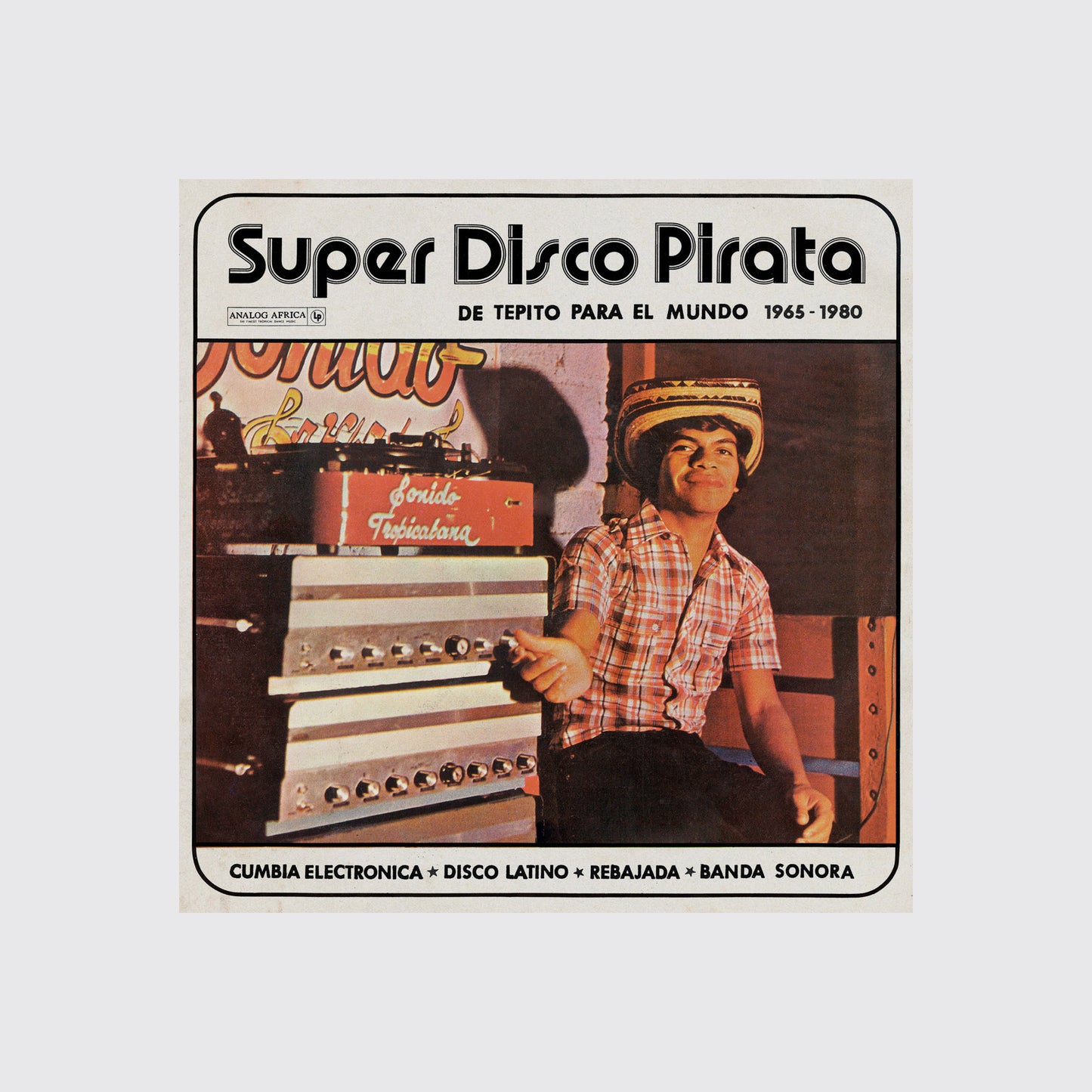
LP / SUPER PIRATE RECORD. From Tepito to the World 1965-1980
LP / SUPER PIRATE RECORD. From Tepito to the World 1965-1980
Couldn't load pickup availability
Super Pirate Disco
From Tepito to the World 1965-1980
Analog Africa No. 39
Double 180-gram disc
Launched on November 15, 2024
Pressed in Germany
"I face a dilemma: how can the founder of an independent record label justify creating a project that highlights—and even praises—piracy, the very plague that has brought many labels to the brink of bankruptcy?"
I first became aware of the existence of "bootleg" LPs in 2020 while searching for records in Mexico City. Their strange, almost handcrafted covers—and the edited, modified, equalized, and slowed-down music they contained—immediately captivated me. There was no doubt: the more I delved into the world of these illicit productions, the more intrigued I became. It soon became clear that one day I would release my own compilation made from bootleg compilations.
But beyond my personal fascination with that parallel world, it was undeniable that the "pirate" movement had played a significant role in shaping Mexico's music scene. So, how did it all begin?
During the 1980s, a group of music dealers and record collectors in Mexico City joined forces to create a series of illegally manufactured vinyl records containing rare and highly sought-after hits from Peru, Ecuador, Colombia, and other countries.
At that time, the city's party and dance scene was dominated by sonideros, a highly developed network of mobile sound system operators. The popularity of the sonideros led to a growing demand for tropical music, as their audience increasingly sought out the "exclusive" hits associated with certain sounds.
At the same time, record retailers were frustrated because the music industry was constantly sending them mediocre records. From this frustration arose the idea of compiling LPs in which every song was a hit. The premise was clear:
“It didn’t matter where the needle landed, it had to be a song capable of igniting the party.”
These bootleg compilations—known as "bootlegs"—were pressed during the night shift on recycled vinyl, in editions of no more than 500 copies. They were produced cheaply and sold equally cheaply to people who otherwise would not have been able to afford them.
These records were constantly played in every corner of Mexico's densely populated neighborhoods, where, in addition to educating the ears of young people, they also promoted some of the best tropical music recordings in all of Latin America.
According to various testimonies, these "pirated" LPs began to mysteriously appear in the early eighties in different market stalls in Tepito, the famous neighborhood of Mexico City, a place where you can find salsa parties during the day, any imaginable drug, any type of weapon and, of course, pirated music in all formats.
It seems that the manufacturers of these records operated under the principle that "what happens in Tepito stays in Tepito," and obtaining information about their operations was difficult, not to say dangerous.
My accomplice in this project—Carlos “Tropicaza” Icaza, who agreed to write the liner notes—was quick to point out:
“We can’t reveal any names. We’ll have to be careful how we tell this story.”
At first, bootleg LPs had very simple generic covers, with invented company names like Discos Music-Hall, Carioca, Garden or Miami, and contained popular dance songs in almost every tropical genre.
As these unlikely compilations became successful and new ones began to be produced at a rate of one per month, the pirates began to design and print much more eye-catching covers, which often included the logos of some of the most popular sounds such as Rolas, Pancho, La Changa, Arco-Iris or Casablanca.
The pioneer of this graphic style was Jaime Ruelas, who had started as a DJ at the legendary mobile disco Polymarchs before using his skills as an illustrator to design its flyers, posters, and logos. Drawing direct inspiration from science fiction films and heavy metal album covers, the graphics he created became a key element of the sound system culture.
Perhaps the anonymous manufacturers didn't know it at the time, but by daring to create bootleg LPs they were helping to consolidate and expand the love for tropical music and dance among the population of Mexico City and beyond.
These records are now a key element of the sound system culture, which was recently declared Intangible Cultural Heritage of Mexico City, due to the impact it has had on multiple generations who identify with the community experience of the street party, where music and dance became an essential part of daily life.
This double LP contains 23 tropical anthems for the dance floor, taken from some of the most extraordinary and strange bootleg LPs produced during the golden age of mobile sound systems in Mexico City.
It also includes an extensive booklet with detailed notes and photographs, and is dedicated to all the sound system operators, for their pioneering role as ambassadors of tropical music within Mexican society."
-Analog Africa-
Tracklist. Duration: 1 hour 15 minutes
1. Lucho Burbano — Afro Oriental — 5:39
2. Cumbia Machuca — Cumbia De Los Bee Gees — 2:40
3. Lucho Gavilanes — El Tequilazo / Canelazo — 2:42
4. Carlos Haayen and His Candeloso Piano — Palenque — 2:05
5. Enrique Lynch — Beethoven's Fifth Symphony — 3:01
6. The Pakines — Venus — 3:53
7. The Protest of Colombia — Cumbia Lament — 3:00
8. Sonora Tropical — Cumbia Rhythm — 3:14
9. Eduardo Zurita — La 3a De Los Toquecitos — 3:23
10. Leon Cardona y Los Internacionales — La Noche — 2:09
11. El Combo Cienaguero — El Compae Nuñez — 2:14
12. Gabriel Meza y Su Órgano Chévere — La Luna y El Pescador — 3:23
13. The Sparkles — You Are Worth as Much as You Have — 4:20
14. Los Diablos Rojos — A Bailar El Son Satánico — 6:51
15. Anibal Angel — Cumbia Tropical — 3:22
16. Camacho and Cano — Make a Wheel — 2:41
17. Rafalo Orchestra — That's With a Candle — 2:32
18. Alex Acosta and His Orchestra — Cumbia Del Amor — 2:55
19. Ramon Ropain — Malinga — 3:30
20. Afrosound — Chinese Platito — 3:25
21. The Sparkles — La China María — 3:05
22. Los Orientales de Paramonga — Te Gusta Como Azúcar — 2:40
23. Francisco Zapata — Cumbia Candelosa — 2:53
This project is dedicated to all the sound system operators in Mexico City.
Graphic design: Yacine Blaiech (Mogli Studio)
Cover: Joaquín Contreras Soto (Contreras.works)
Mastering: Michael Graves (Osiris Studio)
Audio restoration: Jordan McLeod (Osiris Studio)
Album notes: Carlos Tropicaza and Samy Ben Redjeb
Text editing: Jesse Simon
Translation: Brendan James Flannery
Posters and flyers courtesy of Jaime Ruelas
Special thanks to: Eduardo Zurita, Lucho Burbano, José “Morelos” Ortega, César Gómez Montoya (Codiscos), Juan Núñez (Iempsa), Ángel Villanueva (Discos Fuentes), Tony Peñaredonda (Discos Fuentes), Carlos Javier Pérez Samudio (Candelazos Tropicales), Esteban Mendieta Jara (El Surco), Eamon Ore-Giron (DJ Lengua), Jorge Contreras, Mirjam Wirz, Gail Gosschalk, Carlos “4 Frías” Estrada, Mamá Changa, Miguel Cruz Flores (Sonido Continental 2000), Ángel Blancas (Sonido Sensación 2000), Manuel Ramírez (Discos Toño), Ramón Rojo (Sonido La Changa).