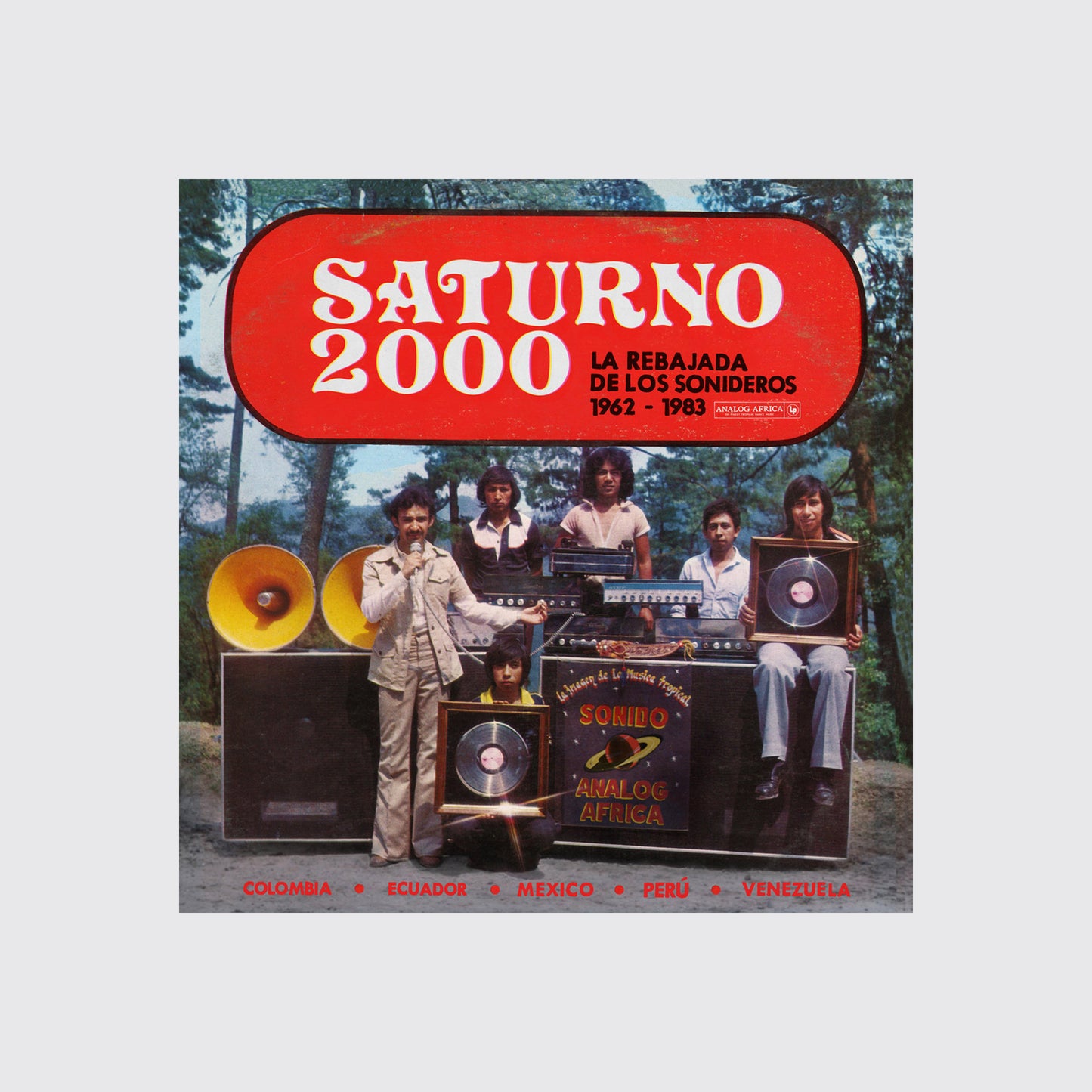
LP / SATURNO 2000. "La Rebajada" of the Sound Systems 1962 - 1983
LP / SATURNO 2000. "La Rebajada" of the Sound Systems 1962 - 1983
Couldn't load pickup availability
Saturn 2000
La Rebajada of the Sound Systems 1962 - 1983
Analog Africa No. 34
Double disc of 180 grams.
Released on April 15, 2022
Pressed in Germany
"It all started in 2010. I asked Eamon Ore-Giron — also known as DJ Lengua — if he would be interested in compiling a Latin project for Analog Africa, and if so, if he had any tracks in mind.
He replied, “Have you ever heard of the discount?”
The question mark above my head, along with the Great Wall of China, must have been the only objects visible from space, because Eamon, probably noticing that I had frozen, continued:
“Rebajada in Spanish means 'to reduce' or 'to lower'. Basically, it consists of Mexican sound system operators slowing down the rhythm of a cumbia to create a much more tangible music for dancing. I'm going to send you a mix I made last year and you can tell me what you think.”
And so he did.
The mix was called "Rebajada Mota Mix," and I started listening to it on repeat. Although it didn't grab me immediately, it was intriguing from the first moment, so I kept listening until the magic began to unfold.
The slowed-down music gives you enough time to listen through it, revealing itself in ways I'd rarely experienced before. Everything became more transparent, and I began to notice sounds normally only perceived by bats. An almost psychedelic experience.
That mysterious mix included some Ecuadorian songs by "Junior y su Equipo"—also known as Polibio Mayorga (a cult figure in the sound system scene), a couple of Mexican tracks, one Colombian track, and several Peruvian songs, undoubtedly the driving force behind this project.
The sound system operator who brought "Peruvian and Ecuadorian music to Mexico" was the legendary Pablo Perea, of Sonido Arco-Iris, and although his influence is throughout the Saturno 2000 compilation, this selection of songs in a reduced version is exclusive to DJ Lengua.
With the exception of some classics by Polibio Mayorga and La Sampuesana —the queen of all the slowed-down songs—, most of these songs had probably never been performed this way, much less published.
So how did the price reduction come about?
In short: the discount began with two families of brothers —the Perea and the Ortega—, who traveled throughout Latin America and returned to Mexico with large quantities of records that they sold to the various sound systems always in search of new songs.
Colombian rhythms seemed to fit almost perfectly with Mexican dance steps—but they were a little too fast. As a result, some sound system operators began experimenting with the equipment, and Marco Antonio Cedillo of Sonido Imperial created a revolutionary pitch control system that could slow down records to a point other players could only dream of.
And so the discount was born… or so we thought.
Meanwhile, in northern Mexico, in Monterrey, DJ Gabriel Dueñez was nearly electrocuted by a short circuit that almost set his record player on fire. As a result, the turntable began spinning in slow motion for the rest of the party, transforming the cumbia into something completely different.
The young people went crazy for the sound and began pestering the sound system operator to record cassettes for them. Initially reluctant, Dueñez eventually started recording a series of bootleg tapes called “Rebajada,” which mainly featured slow versions of cumbia and Colombian porro.
Those tapes swept the city and turned the discount into a celebrated and defiant youth movement.
Of course, it wouldn't be a Mexican urban legend if it didn't include dramatic elements, so for almost 30 years —to this day and probably forever— both cities have been arguing and claiming for themselves the creation of the rebajada.
But Joyce Musicolor, the sound system operator who never has time for trivial discussions, summed it up perfectly:
“The rebajada, and the equipment to play it, are from here [Mexico City], but it was Monterrey that popularized it.”
-Analog Africa-
Tracklist. Duration: 54 minutes.
1. The Dinners — Sampuesana — 3:53
2. Junior and His Team — The Little Drunk Girl — 2:30
3. Manzanita y Su Conjunto — Paga La Cuenta Sinvergüenza — 4:58
4. Hugo Blanco and His Traveling Harp — Infinity — 3:35
5. The Ugly Ones — Feito Parrandero — 3:40
6. Junior and His Team — Well Danced — 4:15
7. The Saints — Saturn 2000 — 3:42
8. Lucho Gavilanes — The Monkey Dance — 3:21
9. Conjunto Típico Contreras — Capricho Egipcio — 3:28
10. The White Cats — The Farmer — 3:22
11. The Atoms of Paramonga — I'm Going East — 4:26
12. Junior and His Team — Rejoice — 3:01
13. Grupo Celeste — I Have Everything From You Except Your Love — 4:48
14. The Echoes — The Bandit's Escape — 5:02
Research and interviews:
Jorge G. Balleza and Oscar G. Balleza, Brendan James Flannery and Yoana Berenice Herrera Orrala
Photos and posters: Yoana Berenice Herrera Orrala (Joyce Musicolor), David Rincón (Champeta Punk), Jorge G. Balleza and Oscar G. Balleza (Sabotaje Media)
This project was made possible with the support of: José “Morelos” Ortega, Jesús Eduardo Sánchez (Sonido Bogotá), Bruno Olvera (Sonido Tropical Olvera), Óscar Solórzano (Sonido El Pato), Gabriel Dueñez (Sonido Dueñez), Miguel Ángel Morales (Sonido Imperial), José Márquez (Sonido Los Freddys), Cirilo Espinoza (Sonido Bayu)
Graphic design: Yacine Blaiech (Mogli Studio) and Kathrin Remest
Mastering: Michael Graves (Osiris Studios)
Lacquers: Frank Merritt (The Carvery)
Text editing: Ian Preece
Special thanks:
Polibio Mayorga, Berardo Hernandez Jr, Alcides Vicente Casas Rojas, Alfonso Saavedra, Marino Valencia, Victor Casahuaman Bendezu, Edilberto Cuestas Chacón, William Rodriguez Martínez, Abel Buenaventura Ortiz Chacón, Marti Cuevas, Luis Flores, Carlos Javier Pérez Samudio, Pedro Pérez Márquez, Chico Unicornio and Eamon Ore-Giron (Sonido Lengua)